[1IP-60] Removal of PriorityFee Cap in Fusion Mode Smart Contract

Simple Summary

  • Deploy a new settlement extension that eliminates the priorityFee cap for Fusion mode Resolvers

  • Signal to 1inch Foundation to update the enforcement terms for Resolvers to reflect this change

Abstract

The proposal aims to remove the gas fee restrictions imposed by the priorityFee cap in the 1inch Fusion mode smart contracts. This change is motivated by the implementation of the Exclusive API, which mitigates Resolver gas price wars and makes the priorityFee cap unnecessary.

Motivation

Current gas fee limitations that were implemented with [1IP-43] are no longer needed due to the introduction of the Exclusive API, which grants resolvers an exclusive window to execute orders without competing in gas price wars. The current priorityFee restrictions disadvantage highly gas-optimized resolvers and lead to inefficiencies.

Removing the priorityFee cap will:

  • Ensure a level playing field for highly gas-optimized resolvers.

  • Enhance the overall efficiency of the 1inch Fusion mode.

Specification

This proposal serves as a signal from the 1inch DAO to 1inch Labs and 1inch Foundation.

Elimination of the PriorityFee Cap:

  • Modify the 1inch Fusion mode smart contracts to remove the priorityFee cap linked to the block’s baseFee.

  • Deploy a new settlement extension

If passed, this proposal signals to 1inch Foundation to update the enforcement terms for Resolvers to reflect these changes.

Rationale

The Exclusive API grants an exclusive slot for the best quote from a Resolver to execute a Fusion mode order, preventing gas price wars that mandated the priorityFee cap.

This change ensures:

  • Alignment with the new system where gas price optimization no longer benefits from the cap, making it redundant.

  • Gas-optimized resolvers are not disadvantaged by the caps.

  • Fair chances for all resolvers to execute orders efficiently.

  • Less value is lost to block builders.

Considerations

This change requires an update and redeployment of the Fusion mode settlement smart contracts. All changes should be thoroughly tested to ensure no negative impact on gas costs and order execution efficiency.
1 Like

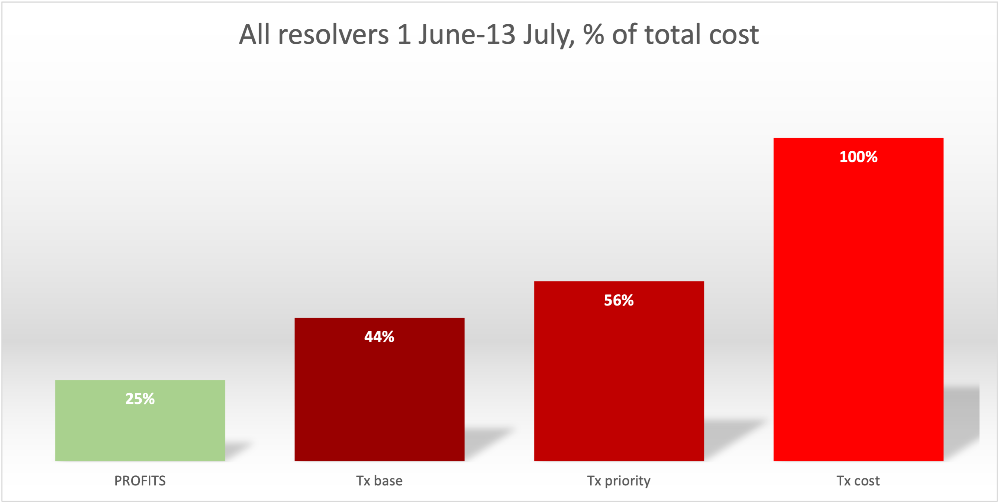
The current proposal lacks effectiveness as it neither resolves existing issues nor enhances the system. Initially, gas wars were a significant problem, with both solvers and users losing money to block builders. As shown in the chart (situation before the policy), without any regulatory policy, this situation was unsustainable.

image
SITUATION BEFORE THE POLICY IMPLEMENTATION: SUMMER 2023

The solution implemented was a policy that capped priority fees and introduced an exclusive order system. This policy has proven successful, reducing gas wars by approximately 80%, as evidenced by blockchain data. The next logical step is to refine the exclusive order system so that solvers can utilize it more efficiently. Although it has not yet been widely adopted by solvers, there are clear areas for improvement and testing that need to be addressed.

Reverting to the previous state of gas wars, which the policy has significantly mitigated, would be counterproductive and contrary to our goals of decentralization and efficiency. Currently, exclusive orders remain underutilized, with most orders still going to auction, despite the potential to completely avoid gas wars and associated costs through their use (anyone can use fill order exclusively already now and end up much better, but hidden gas wars are still happening, so exclusive order don’t fully work). Additionally, exclusive orders are only applied to smaller transactions, while gas wars predominantly affect larger orders.

Regrettably, the current proposal appears to risk undoing the progress we have made, potentially returning us to a far worse situation. While the policy may not be perfect, it has been instrumental in reducing gas wars by around 80%, which is a significant achievement. Our focus should now be on optimizing the exclusive order system, not on reversing the gains we’ve made.

CONCLUSION: It seems like completely conterpruductive proposal that brings back the situation of last summer, that was mostly fixed by the policy.

If the exclusive API were functioning properly, it would automatically resolve the issue regardless of any policy changes. However, suggesting a return to gas wars does nothing to address the problem and would, in fact, worsen the situation for everyone involved.

1 Like

Hey, thanks for the feedback! I passed it along to the core team and here is their response:


We don’t have any proof on profits impact from our side

But we know that:

  • with gas price limitations it’s possible to avoid the rule by passing direct bribe to block builder that is realy hard to catch
  • Gas wars now achieved by spending more gas on execution by simply burning gas inside the smart contract. As soon as all resolvers realized that it’s not forbidden to burn gas, the situation with gas wars will be the same as without priority fee limitations

As always, we encourage you to make your voices heard by voting!