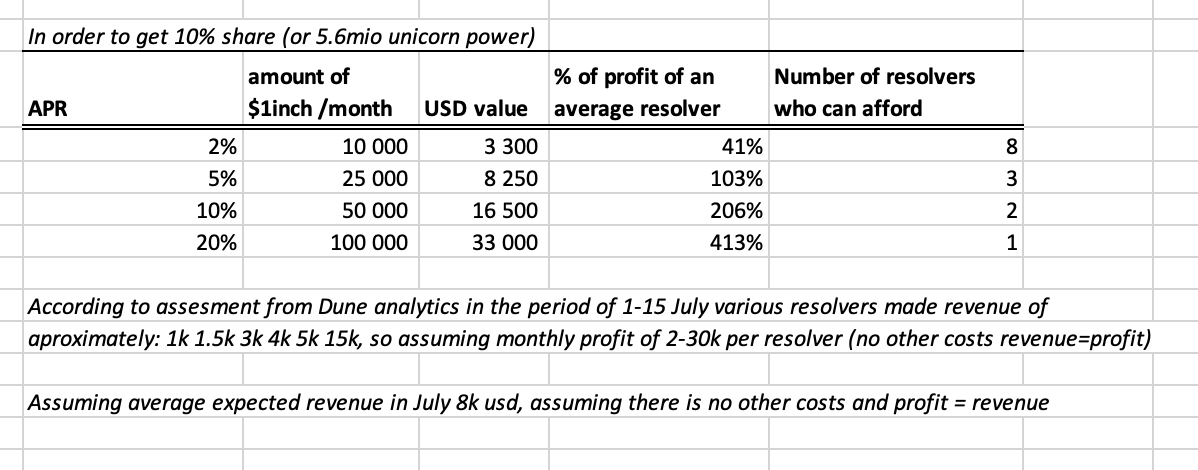
This proposal seeks to introduce a dynamic Fusion mode resolver whitelist in the 1inch Network. This whitelist would be determined by whether a resolver has received delegations of 10% or more of the total Unicorn Power in the network.
Abstract
If passed, this proposal will transition the resolver whitelist for 1inch Fusion mode from a static to a dynamic system. To qualify for the whitelist, a resolver must have received delegations equating to 10% or more of the total Unicorn Power in the network. The maximum limit of resolvers on the whitelist will remain ten (10).
Motivation
The previous move to increase the number of resolvers to ten was intended to foster competition and provide users with better rates. However, this has led to the current scenario where the number of high-quality resolvers is fewer than the spots on the whitelist. The lack of competition has led to a reduction in delegation incentives for stakers.
Transitioning to a dynamic whitelist based on Unicorn Power delegations encourages greater competition among resolvers as they will need to gather enough delegated UP to hit the 10% threshold.
Specification
This proposal serves as a signal from the 1inch Network DAO to 1inch Labs. If the proposal is passed, the 1inch Network DAO calls for 1inch Labs to implement a dynamic whitelist for Fusion mode resolvers, based on a Unicorn Power delegation threshold. Resolvers will need at least 10% of the total network UP in order to be whitelisted.
Rationale
User benefits: This proposal aims to revive the competition among resolvers, ensuring that only the most efficient and committed resolvers participate in the Fusion mode, thereby enhancing service quality.
Resolver benefits: Limiting the number of resolvers to only the most effective ones will concentrate the rewards among fewer participants, driving up the APY and incentivizing more Unicorn Power delegation.
Considerations
1inch Fusion mode has already been audited and deployed. This proposal is anticipated to have no negative security implications as it merely seeks to adjust the number of participants in the first four minutes of the Dutch auction.
Filius from OTEX. We have been active at 1inchFusion since February 2023. These are our comments.
TL;DR
THE REAL ISSUE HERE IS THAT THE PRIORITY FEES THAT ARE BEING PAID TO BLOCK BUILDERS (whom are not doing any actual work at 1inchFusion) ARE FEES THAT COULD INSTEAD BE DISTRIBUTED TO DELEGATES.
We propose to instead introduce rules for the resolver competition in which resolvers are restricted in the amount of priority fee they can pay for their transactions. This will ensure that profit is kept within the participants of the competition and would allow resolvers to distribute significantly higher delegation rewards.
Comments
“This whitelist would be determined by whether a resolver has received delegations of 10% or more of the total Unicorn Power in the network.”
A way to get network share is to know the right people (whales) or to add rewards to the farming pool. The later approach doesn’t necessarily work as expected. 1inch Resolver has 50% of the network delegated to it, but it has been a while since it stopped performing well. My guess is that about ~50% of network is idle at the moment. I could be wrong, but I think a significant amount of those tokens won’t move even if other resolvers have have higher APRs. We saw that in the last months.
Since delegation is only attained via rewards distribution or having a whale backing your Resolver, every new resolver would need to make a significant advanced investment to attempt to make it to the whitelist. This leaves aspiring resolvers pretty much outside of the competition.
“This proposal will transition the resolver whitelist for 1inch Fusion mode from a static to a dynamic system”
Any indication of how often the list would be modified?
“Transitioning to a dynamic whitelist based on Unicorn Power delegations encourages greater competition among resolvers as they will need to gather enough delegated UP to hit the 10% threshold.”
The competition is already there and we, at OTEX, think it is pretty strong. We have been solving trades for a year now and can only look up to some of the Resolvers we are competing with at 1inchFusion. Kudos to them.
The requirement to have a minimum share of the network is actually porposed to push the current Resolvers to give away delegation rewards. This will only force Resolvers to lower their already low net profit margins. Most of the profit is already going to block builders as priority fees (because of the way in which 1inchFusion is designed). We are EASILY allocating about 90% - 99% of the profit to pay priority fees to builders in order to be placed earlier in blocks.
** THE REAL ISSUE HERE IS THAT THE PRIORITY FEES THAT ARE BEING PAID TO BLOCK BUILDERS (whom are not doing any actual work at 1inchFusion) ARE FEES THAT COULD INSTEAD BE DISTRIBUTED TO DELEGATES. **
“Fewer resolvers reduces gas costs for settlement – improving rates for the user.”
This is not fully true within the current auction model at 1inchFusion. Fewer resolvers will indeed reduce the gas costs of executing a settlement (by a marginal ~1.5%, which is actually nothing), but resolvers will inevitably add that cost reduction as priority fee to ensure they are placed above other resolvers within the block. In other words, users won’t see any of the pennies saved from this 1.5% gas reduction.
Counter Proposal
Instead of enforcing a 10% network require, we would propose the introduction of a competition rule that limits the size of the priority fees resolvers are allowed to push relative to the revenue of their settlements. This would allow resolvers to improve their gross profit margins and distribute larger farming rewards to their delegates.
Resolvers currently only receive around 20% of transaction settlement fees. The remaining 80% is distributed to miners and block builders. This implies a significant imbalance in the system;
A substantial sum, tallying up to hundreds of thousands of USD, is allocated to block builders each month. A fraction of these funds, if redirected to delegates for transaction settlement, could drastically alter the current state of affairs;
Presently, the system does not incentivize delegates, and disproportionate rewards are allotted to block builders;
We’re caught in a classic game theory predicament, akin to the “Prisoner’s Dilemma”, where all resolvers are at a financial loss due to high priority fees. The absence of clear rules or agreement creates a system vulnerable to exploitation. A standardized framework by authority can rectify this problem, similar to anti-monopoly laws in the market. This what classic game theory suggest.
If proposal is implemented
The financial burden on resolvers would increase even more, and this cost will likely be passed on to users;
The proposed system would raise the entry barrier for resolvers, impacting network decentralization negatively;
The pre-investment to become a resolver would need to be significantly higher, around 2’000’000 USD, making it less accessible to many.
Evaluation of the New Proposal
The beneficiaries of the new proposal are the block builders while users end up bearing more costs. Alternatively, both resolvers and users pay more, which is not an ideal situation either.
Counter-Proposal Ideas (to be developed)
If we implement rules that restrict the unfair financial gains of block builders:
Resolvers’ profits could multiply by at least three times, enabling them to share part of this profit with delegates more easily;
Users would benefit from improved rates on Fusion at the same time;
The low entry barrier for resolvers would encourage competition and decentralization.
Another raw idea may include:
Implement a “low priority fee” rule;
Cap the maximum transaction share a resolver can have at a predetermined level, say 10%, plus a percentage of their network share.
Benefits:
Resolvers, users, and delegates all stand to benefit;
The entry barrier remains low, promoting decentralization of 1inch;
New resolvers can enter the market gradually;
The most efficient resolvers are rewarded with the best trades and transaction volumes.
In an effort to maintain transparency, the following is a simple scenario analysis that anyone can replicate using open data available on Dune:
Our current situation is precarious; there is a potential risk that
one or two large resolvers could establish dominance (affording high apr), driving other participants out of the market!
the barrier to entry would become extremely high, deterring new participants!
Monopolization not only poses a threat to our goal of decentralization, but it also limits diversification within the network. Currently, we have a diverse range of resolvers. Some manage smaller trade volumes and yield lower profits, while others handle a larger number of transactions. This system offers a level of inherent diversification. Smaller resolvers remain competitive however (winning certain trades! and bringing value to the system!), possibly specializing in specific types of trades and gradually developing their capacities. Our latest proposal aimed to increase the number of resolvers from 5 to 10 to enhance this decentralization and diversification, and to lower the entry barrier.
The implementation of the proposal may jeopardize this balanced ecosystem. Smaller, specialized resolvers could be pushed out of the market. This raises several critical questions:
Is this scenario beneficial or detrimental to the decentralization of the network?
How will it impact the diversification and specialization within the system?
What are the implications for the entry barrier?
_In response to these concerns, I propose an alternative solution: Create a dynamic list of resolvers with a 2% threshold. This approach would accommodate both large and small players, promoting a healthier, more competitive environment. _
_Furthermore, it’s crucial to address the “elephant in the room” — the issue of profits going to extremely high priority fees, as said before. _
The core developers have reviewed the feedback provided here and agree that some optimizations can be done to Fusion mode that will alleviate the gas wars. However, they believe that this issue is orthogonal to the issue of the inflated resolver whitelist (the gas costs associated with transaction settlement scale with the number of resolvers in the whitelist, so shortening the list will improve base rates for users). This separate issue should be handled with a separate proposal.
With that said, there seems to have been some sort of sybil/sock-puppet brigading of this phase-3 temperature-check vote. In past temperature check votes it has been rare to get over 10 individual votes cast – this one closed with 126 votes.
Since every vote was tied to the Ethereum account that the user logged in with, we did a review of those accounts to try to determine if they are legitimate individuals or sockpuppets controlled by a few. These are the results:
yesVotesWithMoreThanZeroTxn: 32
noVotesWithMoreThanZeroTxn: 17
yesVotesWithZeroTxn: 7
noVotesWithZeroTxn: 70
So, if we just count the votes that are most likely to be real individuals, aka the votes cast by addresses that have made prior transactions, the yes votes outnumber the no votes by nearly a 2-to-1 margin. Conversely, the number of no votes cast by fresh accounts outnumbers the amount of new account yes votes by a 10-to-1 margin.
Obviously, this alone is not conclusive proof that sock puppets were used to brigade the forum, but we argue that it is sufficient evidence to cast doubt on the validity of this temperature check vote and proceed to the phase-4 vote to adjudicate this dilemma.
Going forward, members of the DAO will be looking into ways to make the temperature check vote more sybil resistant.
Hi All, Mark here from Shipyard (developer of Clipper.exchange). We just worked hard on a resolver and launched it, but now are going to be at a structural disadvantage in generating yield to attract UP delegation. This risks driving our resolver (and other newer/smaller/specialty resolvers) out of business and making the resolver pool even smaller and less diverse at exactly the same time UniswapX is launching their Fusion competitor.
With respect to the purported brigading, I think there were probably 10x the votes than a normal proposal because this proposal really matter to all the smaller resolvers that are trying to grow. I know in the Clipper Community, 1inch users rallied to vote against this temperature check. I also know that I personally vote on most governance proposals with an empty wallet to preserve privacy, so I’m not sure the ‘zero txs’ dimension tells us much about whether the votes were real humans or not. In other words, it seems like the will of the community is getting overruled by confusing sybilling with genuine engagement in governance and grassroots political action.
At this point, it looks like whales are going to pass the proposal. But this does not seem like good form was followed to promote the failed temperature check to a snapshot and for that reason I don’t think the snapshot proposal should be valid anymore than a corporate action that violates the bylaws would be valid. In the meantime, I encourage 1inch voters to vote DOWN the snapshot proposal until there has been a more robust debate on the impacts of this change on the community of newer resolvers and how we’ll prevent monopolistic/centralization of resolving.
This decision will lead to strong competition. Yes, it will be harder for resolvers to get whitelisted. But if you look at this proposal from the community and user side, it is a good proposal.
Users will experience an improved quality of service in Fusion mode, also with fewer resolvers on the whitelist that perform settlements and transactions, gas costs will go down.
I agree that this solution is very inconvenient for most resolvers. But I would advise to look for the upside and new opportunities in everything
In the short-term, perhaps if gas costs will indeed go down (and I think you’re saying that is separate and distinct from the gas-war issues that are currently happening).
But in the long-term, it reduces the incentive for new resolvers to start up and makes it harder for them to survive because incumbents will have a large structural advantage. Won’t that hurt users in the long-run? ?Fewer resolvers competing to fill orders means fewer liquidity sources integrated and worse execution for users. Ultimately, that ends up worse for the community.
Case in point is the resolver we built specifically for Clipper. Clipper has better prices and gas for blue chip swaps (e.g. ETH<>USD) than Uniswap. If our resolver can’t compete on a level playing field, users will not get the benefit of Clipper swaps.
The amazing thing about Fusion is that it essentially removes the integration bottleneck from 1inch team and enables the rapid integration of infinitely new and more varied liquidity sources by enabling the market to do that integration work instead. This ultimately benefits users by giving them more liquidity sources.
Tilting the scales towards a a couple big resolvers just reintroduces the integration bottleneck and makes it harder for new liquidity sources to emerge and hurts users and the community long-term.
It seems to me that the emphasis here is not on the number of resolvers, but on their quality. The decision to reduce the number of resolvers and make a whitelist was thoughtfully made in order to improve the quality of service provision.
This is my personal opinion
*Edited
Thanks for adding the case, I didn’t see it right away. Yeah, it’s a interested case.
No matter how high quality, I don’t think any one resolver (or even three) can integrate all liquidity sources. The number and variety of liquidity sources is growing every day, and keeping up with integrations is simply an impossible task for a centralized group. The only solution is to have a marketplace of resolvers - as many as possible.
But if you advantage a few incumbents, no matter how high their quality, you disadvantage the rest, make it hard for them to compete. Pricing differences are already so small that this disadvantage will drive them out of business, and deter new ones from starting. The collective integration backlog will grow longer and longer and there will be less innovation in routing algorithms.
I think in the long-run users benefit more from more liquidity sources and new routing solutions. There are other solutions to the gas/priority fee problem that dont limit user choice.
you wrote " But if you advantage a few incumbents, no matter how high their quality, you disadvantage the rest, make it hard for them to compete", why regardless of their quality? on the contrary, depending on their quality. The number of resolvers may be not 1, 2 or 3, but all 10.
most likely the situation is that even if there are more than 50 resolvers, users will choose those who will be in the top 5. Most resolvers will receive very little attention from users and provide a very low APR
1inch holders will delegate their UP to the resolver paying the highest yield. Whoever are the incumbents on the whitelist get first crack at transactions, which means they will be more profitable than everyone else. That means they can afford to pay a higher yield than everyone else. How is a new resolver ever supposed to pay enough yield to attract 10% of UP when they are handicapped compared to incumbents? In theory, it’s possible if their execution edge exceeds the handicap. But this market is hyper competitive - execution edge is measured in bps, so its unlikely their edge could outweigh even a small handicap.
The end result of this system is a few incumbent resolvers with path-dependent success who will be delegated virtually all of the UP. New resolvers will never have a shot at achieving the 10% threshold unless they do a side deal with a big whale or tie up a ton of VC capital, and as a result new resolvers simply won’t bother trying to start.
The end result will be deterring innovation which long-term worsens execution for users AND 1inch holders who could earn even more yield from more innovative resolvers. On a strategic level, its will drive talented innovators to invest their development efforts in UniswapX instead of 1inch Fusion.
Personally, I don’t think that result is beneficial for anyone in the 1inch community, except perhaps the few incumbent resolvers.